




Discoveries
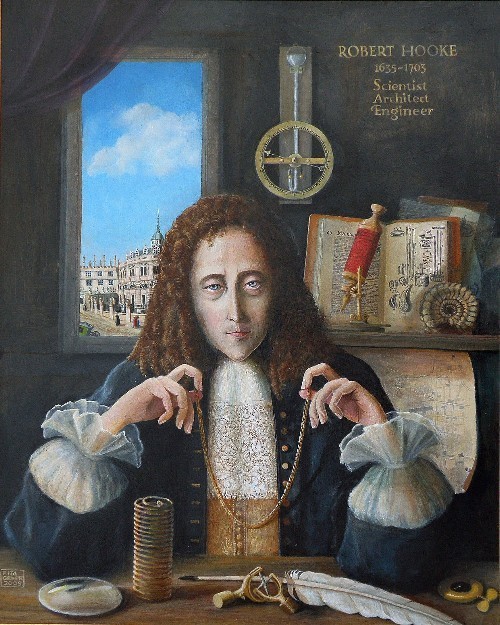
Robert Hooke’s discoveries are almost too many to name, but he certainly deserves the name ‘the English Leonardo da Vinci’. He was a true renaissance man in the early beginnings of the period we today know as ‘the Enlightenment’.
Firstly, Hooke discovered what would come to be called Hooke’s Law, or the law of elasticity. Essentially, this law states that a solid body stretches proportionally to the force applied to it. Hooke’s Law became an essential component of many fields, but especially solid mechanics, which Newton would also later revolutionize. It also greatly improved watch mechanisms of the time, leading to some of the first precise watches in the world.
As an astronomer, he plotted the course of the earth and moon’s orbit around the sun, observed new stars, sketched Mars and suggested Jupiter rotated on its axis. He was also one of the first to use what we today consider a modern telescope.
Turning his gaze from the heavens to the world of biology, Hooke developed a microscope and used it to observe the cells of a tree’s bark for the first time. It’s from Hooke that we get the word ‘cell’, supposedly because he believed the cells reminded him of a monk’s sleeping cell.
He also observed many fossils, concluding that they had once been living things that had died out, rather than ancient examples of still living creatures. The idea may seem benign to use today, but in Hooke’s time, it flew in the face of religious teachings and so gained little traction. His observations didn’t stop there, however, and he gave us some of the first truly accurate examples of insects such as fleas, flies and even silkworms in his book Micrographia, which is widely considered to be one of the bestselling science books of all time.
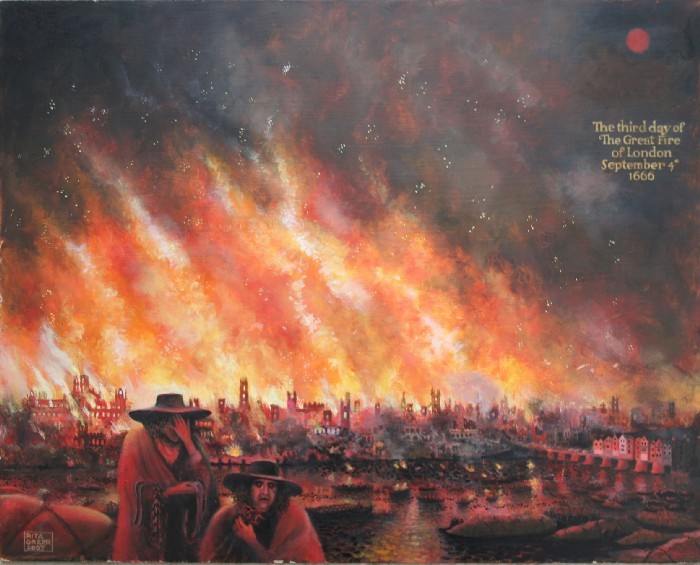
Hooke also turned his hand to architecture, designing the monument to the Great Fire of London with Sir Christopher Wren, contributing to the design of the Royal Greenwich Observatory; he even proposed a method for constructing the new dome on St Paul’s Cathedral.




Comments
0 comment