





A Marvel Of Ancient Roman Urban Planning
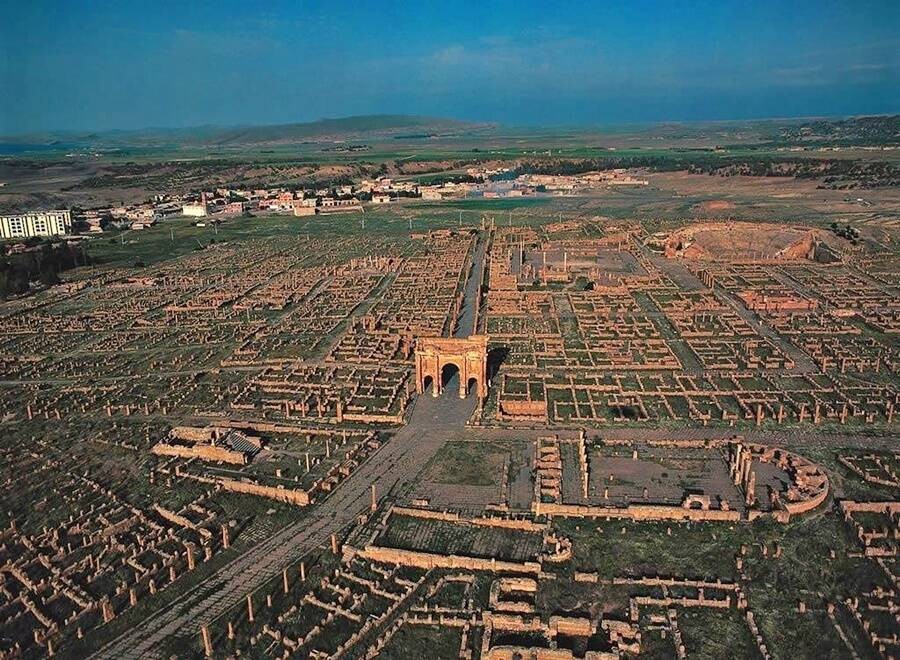 Timgad's meticulously planned grid of city streets has been perfectly preserved by the desert sands.
he ancient city of Timgad boasted a number of temples and bathhouses, a variety of residences for different classes of society, as well as a forum area, a public library, markets, a theater, and a basilica.
There was no previous settlement on the grounds when Timgad was built, so it was constructed from scratch, using the Roman grid system. It has a perfectly square shape, with several major intersections inside the city allowing traffic to flow smoothly.
Like in all Roman cities, the street that ran north to south in Timgad was known as the cardo. The street that ran east to west was called decumanus. Unlike other typical Roman cities, however, Timgad's cardo did not cross through the entire length of the city. Instead, the street ended at Timgad's center, at its forum.
Timgad's forum area is another distinct urban detail used by the Romans. The Romans used forums as a public square where residents could buy or sell goods, or for other public gatherings.
Not far to the south of the forum was Timgad's theater. The theater was built around 160 AD and could seat about 350 people for each performance. The theater appears to have been cut directly from a nearby hill and, to this day, remains largely intact.
Two-thousand years later, Timgad stands as one of the most remarkable archaeological sites in the world. Its advanced urban structure, though in ruins, remains an impressive sight to behold.
Timgad briefly revived as a Christian city when the Byzantines conquered its territory in the 6th century. But after Berbers sacked it in the 7th century, residents abandoned Timgad again.
Left unprotected, the Sahara Desert moved in and buried the city. Timgad wouldn't be discovered again until 1,000 years later when a team of explorers came upon the site while traveling through North Africa.
The rediscovery of the ancient city is largely credited to James Bruce, a Scottish nobleman who served as the British consul in Algiers — now the capital city of Algeria — in 1763.
Bruce left his consulate after an explosive disagreement with his superiors based in London. But instead of returning back to England, Bruce teamed up with Florentine artist Luigi Balugani and embarked on a trip across Africa.
Bruce and Balugani reached the site of Timgad on Dec. 12, 1765. They are believed to be the first Europeans to visit the site in centuries.
Bruce, enamored by the ruins of the vast city in the middle of the desert, wrote in his diary, "It has been a small town, but full of elegant buildings." Based on what he knew about North African history, Bruce was confident that the pair had found Emperor Trajan's long-lost city.
But when Bruce finally returned to London to share his incredible findings, nobody believed him. Undeterred, Bruce left for Scotland. He spent his retirement writing about his travels in Africa and his discovery of Timgad. Bruce's notes turned into a five-volume book titled Travels to Discover the Source of the Nile that was published in 1790.
It took another century before one of his successors, Robert Lambert Playfair, the new British consul to Algiers in 1875, retraced Bruce's steps in North Africa. Here, Playfair found Timgad. Even a century later, the city was largely preserved by the dry sands of the Sahara.
Subsequent excavations of the city led to its designation as a World Heritage Site by UNESCO in 1982. Many Timgad ruins still stand today, including its signature arch—known as the "Arch of Trajan"—and its theater, which still hosts the occasional concert.
Timgad is an enduring symbol of Roman history. This ancient site offers a rare look at how Romans lived centuries ago.








Comments
0 comment