




A Birth Worthy of a Horror Film
The story begins in 1488 with a teenage orphan named Agatha. Having refused to name the father of her unborn child—even when hauled before a local magistrate—she gave birth in a cave by the River Nidd during a violent thunderstorm . As origin stories go, it’s dramatic enough. But the rumours that followed were far worse: it was whispered that Agatha had conceived the child with Satan himself .
The baby, Ursula Southeil (spellings vary wildly, from Sontheil to Soothtell), was reportedly born with a hunched back, “great goggling” eyes, and a nose of “incredible and unproportionable length” . She was said to have cackled rather than cried, and at least one account claims her foster mother once returned home to find the naked toddler clinging to the wall above the fireplace, surrounded by the sound of “a thousand cats” wailing . If that doesn’t make you the weird kid at school, nothing will.
Agatha raised Ursula in the cave for two years before a sympathetic abbot intervened, placing Agatha in a convent and Ursula with a foster family. Mother and daughter never saw each other again .
From “Hag Face” to Herbalist
Growing up with a hunched back and a face that inspired local children to call her “hag face,” Ursula sought solace in the woods around her birthplace . There, she developed an encyclopaedic knowledge of local plants and herbs, eventually earning a living as a herbalist. She even married—a carpenter named Toby Shipton, whose surname she adopted. The marriage was brief; Toby died a few years later, and dark rumours circulated that Ursula had somehow caused it .
Once again an outcast, she returned to the woods and embraced her reputation as a wise woman and seer.

The Prophecies That Made Her Famous
Mother Shipton’s most celebrated prophecy—the one that allegedly made her a household name—concerned Cardinal Thomas Wolsey. Wolsey, a powerful figure in Henry VIII’s court, had been made Archbishop of York but had never actually visited the city. When he finally planned a trip north in 1529, Mother Shipton predicted he would never reach it .
Wolsey, understandably annoyed, sent three men—the Duke of Suffolk, Lord Percy, and Lord Darcy—to intimidate her . Whatever they encountered apparently impressed them, because the prophecy was recorded and circulated. Wolsey, approaching York, was summoned back to London by the King and died on the journey . The prediction’s accuracy propelled Mother Shipton into national fame.
Other prophecies attributed to her include the dissolution of the monasteries, the rise of Elizabeth I, the defeat of the Spanish Armada, the execution of Mary, Queen of Scots, and the Great Fire of London . Samuel Pepys, surveying the fire’s devastation in 1666, noted in his diary that the Royal Family discussed Mother Shipton’s prophecy of the event . When a prophecy reaches the diary of the era’s most famous civil servant, you know you’ve made it.
The Witchification of Mother Shipton
Here’s where things get complicated. The earliest surviving record of Mother Shipton is a pamphlet from 1641—eighty years after her reported death in 1561 . She never wrote anything down herself. Everything we “know” comes from oral tradition and later publications, many of which had agendas.
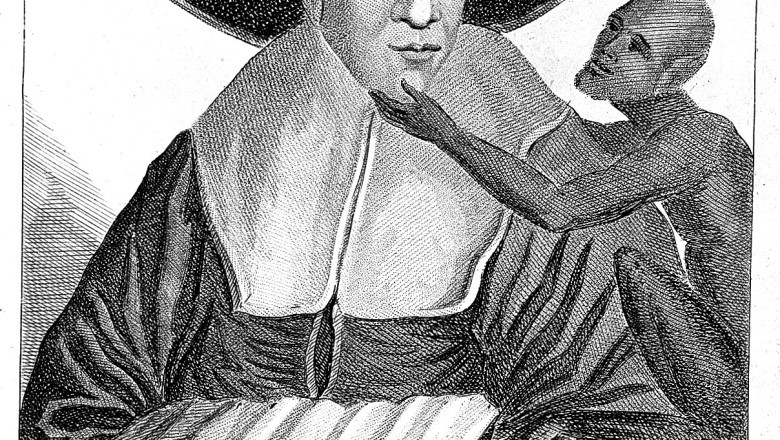
After 1641, pamphlets began depicting Mother Shipton as an increasingly grotesque caricature of a witch. By 1667, the bawdy novelist Richard Head had published The Life and Death of Mother Shipton, complete with illustrations showing her bent double with extreme haggardness . The timing was no accident. As historian Darren Oldridge has observed, her fluid identity as both prophet and witch served the religious and political propaganda of the English Civil War period .
Mother Shipton became the archetypal witch—hooked nose, warts, the lot. When a butterfly was discovered with a pattern resembling that profile, it was named the “Mother Shipton” moth . Her image in early pantomime is even believed to be the forerunner of the Pantomime Dame .
But there’s a twist. As the witchcraft fever subsided after 1700 and the Age of Enlightenment took hold, Mother Shipton reverted to her original incarnation as a prophetess. Visual representations toned down the witchy features, and her familiar was replaced by a scroll of prophecies . In 2017, Knaresborough unveiled a bronze statue of her in the Market Square, deliberately avoiding the witch caricature. Sculptor Chris Kelly noted that “in the first known literary print of her she appears as a well-dressed noble woman, not as a witch at all” .
The Fake Prophecy That Refuses to Die
Perhaps the most famous Mother Shipton prophecy of all is also the most fraudulent. You’ve probably heard it:
The world to an end shall come
In eighteen hundred and eighty one.
This little gem, along with the lines about “carriages without horses” and “iron in the water shall float,” was not written by a Tudor prophetess. It was composed by Charles Hindley, a Brighton bookseller, who admitted in 1873 to Notes and Queries that he had invented the verses for an 1862 edition . Hindley’s fabrication has since been republished with different dates—1981, 1991—and quoted as genuine countless times . It’s a testament to Mother Shipton’s cultural staying power that even a confessed forgery couldn’t tarnish her reputation.

The Cave That Turns Teddy Bears to Stone
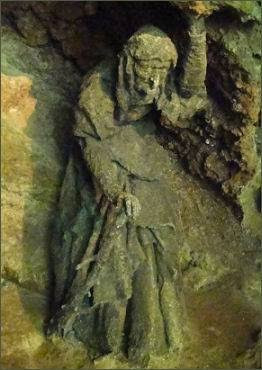
Today, Mother Shipton’s Cave operates as one of England’s oldest tourist attractions, welcoming paying visitors since 1630 and now attracting over 65,000 people annually . The site’s other star attraction is the Petrifying Well, a natural geological phenomenon where water rich in calcium carbonate flows over objects, gradually coating them in a mineral shell. A small teddy bear takes three to five months to petrify; visitors can hang items in the well and return later to collect their stone-crusted treasures .
The gift shop sells fossilised teddy bears and witch-themed merchandise, which is exactly the kind of delightful oddity you’d expect from a place associated with a woman who may or may not have been the Devil’s daughter .
So, Did She Actually Exist?
Historians largely believe Mother Shipton was a real woman. In 1537, Henry VIII wrote a letter referring to a “witch of York,” which is thought to be the earliest contemporary reference to her . The 1641 pamphlet’s restrained account of her Wolsey prophecy has been called “historically convincing” by historian Arnold Kellett, who argues that a fabricated tale would have been far more sensational .
What’s certain is that Mother Shipton’s name became attached to countless tragic events and strange occurrences across Britain, North America, and Australia throughout the 17th, 18th, and 19th centuries . She became a blank canvas onto which each era projected its fears and fascinations—witchcraft, political upheaval, the apocalypse, and now, mildly unsettling petrified teddies.
Whether she was a genuine seer, a maligned herbalist, or a convenient fictional figure, Mother Shipton endures. She’s Yorkshire’s answer to Nostradamus, a woman who spoke truth to power and paid for it with a reputation as the Devil’s spawn. And if you ever find yourself in Knaresborough, you can visit her cave, make a wish at the well, and watch a teddy bear slowly turn to stone. It’s not everyone’s idea of a day out. But then again, Mother Shipton was never everyone’s idea of a prophetess.
References
The earliest known record: The 1641 pamphlet, "The Prophesie of Mother Shipton, In the Raigne of King Henry the Eighth" is considered the first existing record. It is held in the British Museum and a reprint is available via the University of Oxford.
The 1684 edition: One of the most notable early publications of her prophecies.
Charles Hindley's admission: In the 26 April 1873 issue of Notes and Queries, Charles Hindley admitted to inventing the famous "1881" end-of-the-world prophecy.
Samuel Pepys' diary: The entry for 20 October 1666 records the Royal Family discussing Mother Shipton's prophecy of the Great Fire of London.
William Lilly's version: The astrologer published a version in 1645 titled "A Collection of Ancient and Moderne Prophesies" which contained "Shipton's Prophecy, after the most exact Copy".
W.H. Harrison's investigation: The 1881 book "Mother Shipton Investigated" critically examined the literature in the British Museum Library.
Visitor attraction details: Information about Mother Shipton's Cave, the Petrifying Well, and its status as England's oldest visitor attraction (open since 1630) is documented by Yorkshire.com and Visit North Yorkshire.












Comments
0 comment