



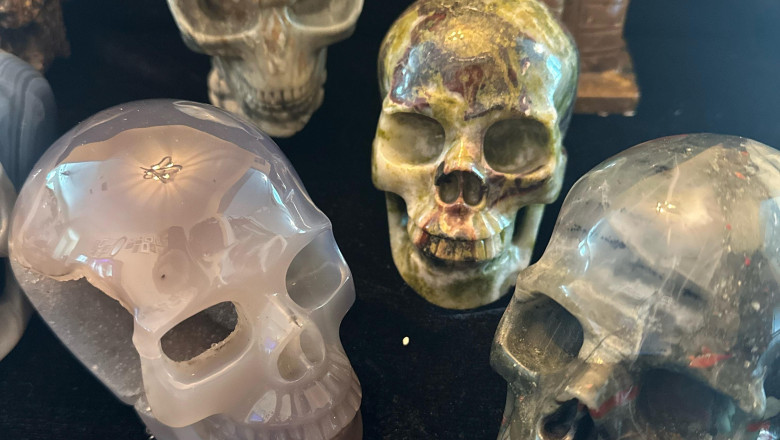

The aura of enigma enshrouding the infamous Crystal Skulls transcends the ordinary, whisking the imagination into the realms of the forgotten prehistory, science, and the supernatural. This phenomenon's allure emanates from the atom-sized mysteries buried exhibit their immaculate craftsmanship.
The first known reference to the Crystal Skulls appears during the heights of the 19th-century European fascination with artefacts from the New World. It was then that larger-than-life adventurers dashed back to Europe and North America with these skulls. Ever since, the Crystal Skulls have mystified scientists, historians, and spirituality enthusiasts alike.
Varying in size, each Skull has been meticulously carved from single blocks of quartz or rock crystal, hence the name 'Crystal Skulls.' Several of these skulls are held in prominent collections worldwide, with a few notable examples residing in the British Museum, the Smithsonian, and Paris's Musée du quai Branly.
The most renowned of the Crystal Skulls is the Mitchell-Hedges Skull. Named after its discoverer, the British adventurer F. A. Mitchell-Hedges, this skull was found at a Maya ruin in Belize in 1924. Unsurprisingly, the skull is often called the 'Skull of Doom.' Indeed, its exceptional detail, including removable jaws, is unprecedented in Mesoamerican art, feeding into the reputation of the Crystal Skulls as unexplainable artefacts.
For years, the origins of the Crystal Skulls were as obscure as their purpose. Many have hypothesised these masterpieces of craftsmanship had links to the Ancient Maya culture. Unsurprisingly, this continent-spanning civilisation's obsession with skulls is extensively documented, with skull motifs appearing on ceramics, textiles, and even entire buildings, like the Templo Mayor in Tenochtitlan, now Mexico City.
However, scientific studies funded by the Smithsonian and conducted in collaboration with the British Museum began to unfurl the aged mystery. Eventually, it was concluded that the supposed 'pre-Columbian' origins were fraudulent.
Utilising electron microscopes, researchers uncovered distinctive tool marks indicating the skulls were made with modern, rotary-style carving tools. The quartz’s source too was pinpointed to Brazil or Madagascar, both lying outside the pre-Columbian trade routes, laying further credibility to the claim of the skulls being modern forgeries.
The enigma does not merely cease with debunking the claimed pre-Columbian origins. Local folklores are rife with tales about the supernatural powers harbouring within the skulls. From exhibiting psychic powers to preserving ancient knowledge of extinct civilisations, the thread between the Crystal Skulls and the supernatural seems inexorably interwoven.
Embracing this aura, the New Age Community links the twelve Crystal Skulls to the 'end of times' prophecy and the Mayan long-count calendar. Nevertheless, despite the speculations, there has been no scientific evidence proving the skulls' supernatural abilities, making their true significance perhaps the greatest mystery of all.
From engendering intense curiosity to imbuing tales of supernatural powers, the Crystal Skulls project an intricate pageantry of science and spirituality. Divorcing these two can detach the mystery from the physical artefacts, yet taking both hand-in-hand may spin intriguing tales. Nonetheless, it is safe to say that these artefacts of inexplicable beauty and meticulous craftsmanship offer charismatic glimpses into the splendour of human imagination.
Even without their mystical origins, the Crystal Skulls remain spectacular. Their romance and intrigue lie not in their utilitarian value but within their grand narratives, drawing from both science and folklore. As the story unfolds between the realms of history, science, and spirituality, the Crystal Skulls promise to live in the hearts of the curious forever.
References:
- Walsh, Jane MacLaren. "Legend of the Crystal Skulls." Archaeology, www.archaeology.org/0805/etc/indy.html.
- Tapsell, Ruth. "The crystal skull." British Museum, www.blog.britishmuseum.org/the-crystal-skull.
- Sax, Margaret, et al. "The origins of two purportedly pre-Columbian Mexican crystal skulls." Journal of Archaeological Science, vol.35, no.10, 2008, pp. 2751-2760.










Comments
0 comment