



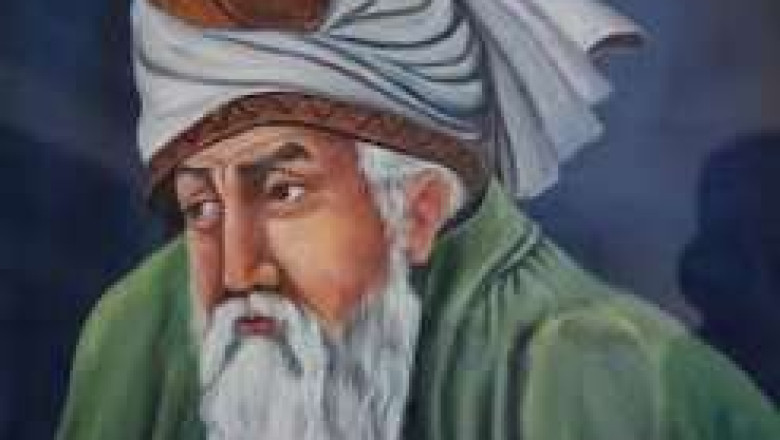

Jalal al-Din Muhammad Rumi never set out to become the world's most beloved poet. Born in 1207 on the eastern edge of the Persian Empire, in what is now Afghanistan or Tajikistan, he inherited a life of scholarly certainty, not ecstatic verse. His father, Baha al-Din Walad, was a renowned theologian, a man so respected that followers called him 'Sultan of the Scholars'.
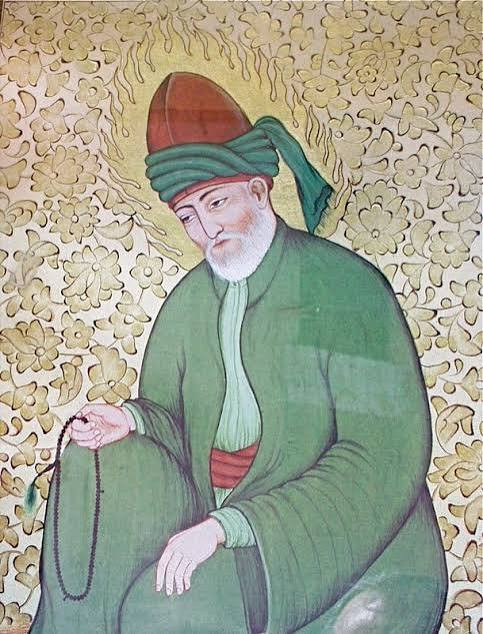
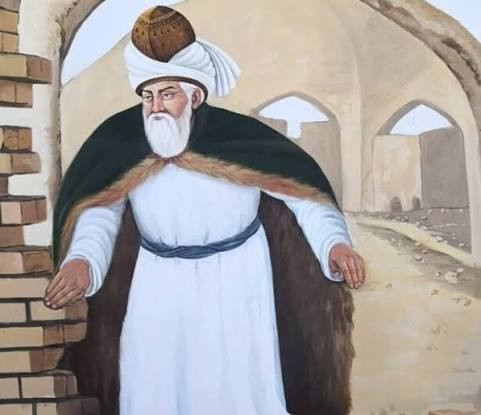
Young Rumi was raised to follow this path—a life of jurisprudence, of sermons, of clear answers and established authority. He studied in Aleppo and Damascus, absorbed the rigorous traditions of Islamic law, and returned to Konya, in present-day Turkey, to take his father's place as a teacher. He wore the black turban of a respected scholar. He issued fatwas. He taught students. He was, by all accounts, successful and respected.
Then, in 1244, a stranger appeared in Konya, and everything Rumi thought he knew about himself, about God, and about the world fell apart.
The Meeting That Broke the World Open
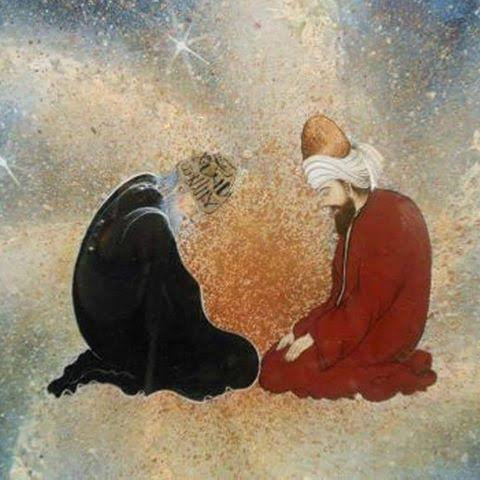
The stranger was Shams al-Din Tabrizi, a wandering mystic who moved through the world like a man possessed—because he was. Shams lived in a state of such fierce, uncompromising intimacy with the divine that he had little patience for the niceties of polite religious society. He had spent years searching for someone who could bear his company, someone whose soul burned with a fire equal to his own. He found that fire in Rumi.
Their meeting has become one of the great spiritual turning points in history. The hagiographies tell us that Shams asked Rumi a question that cut through all his learning: who was greater—the Prophet Muhammad or the mystic Bayazid Bistami? Rumi gave the expected answer: Muhammad, of course. Shams challenged him: then why did Muhammad say, "We have not known You as You deserve to be known," while Bayazid proclaimed, "Glory be to me! How great is my majesty!" The question, simple and devastating, exposed the difference between knowledge about God and knowledge of God. It shattered Rumi's reliance on second-hand certainty. He could lecture on love; Shams was consumed by it.
For the next few years, the two men were inseparable. Rumi abandoned his teaching post. He neglected his students. He sat with Shams for hours, days, lost in conversations that seemed to peel back the skin of reality. His followers grew jealous. They saw this strange, ragged dervish leading their esteemed master away from his duties, from his reputation, from them. They drove Shams away from Konya. Rumi was inconsolable and sent his son to bring him back. Shams returned, but the tension proved unbearable. In December 1248, Shams disappeared for good. The story says he was murdered, possibly with the connivance of Rumi's own son, Ala al-Din. If so, Shams truly gave his head for the privilege of divine friendship.
The Poetry of Loss
Rumi did not retreat into mourning. He erupted.
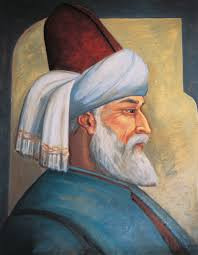
Grief did not silence him; it turned him into a human geyser of poetry. Over the next twenty-five years, he poured out more than 40,000 lyric verses. This outpouring, collected as the Divan-e Shams-e Tabrizi ("The Collected Poems of Shams"), represents a paradox: a work of staggering originality written in the voice of another man. Rumi did not claim these poems as his own. He wrote them as if Shams were speaking through him. The Divan is love poetry, but its object is not a human beloved. It is God, mediated through the memory of a man who had shown him the way to union. The poems whirl through themes of longing and ecstasy, separation and reunion, annihilation and resurrection. They are raw and immediate, speaking directly to the reader in the second person, as though Rumi is reaching across the centuries to shake you awake.
But the Divan was only the beginning. Around 1262, Rumi began dictating a different kind of work to his scribe, Husam al-Din Chalabi. He called it the Masnavi-ye Ma'navi, or "Spiritual Couplets"—a six-volume poem that runs to over 64,000 lines. The Masnavi is a different beast. It is not the spontaneous overflow of grief; it is a deliberate, sustained act of teaching. Rumi once called it "the roots of the roots of the roots of the (Islamic) Religion," and scholars have dubbed it the "Persian Koran". The title acknowledges its ambition: to do in Persian verse what the Quran does in Arabic prose—to guide, to illuminate, to transform.
The Philosophy of Love and Annihilation
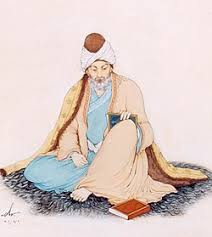
To read the Masnavi is to enter a world that defies easy categorisation. It contains fables, jokes, sermons, Quranic exegesis, ribald stories, and soaring metaphysical speculations, all woven together in a sprawling, digressive tapestry. If we search for a systematic philosophy, we find something more powerful: a coherent vision of existence held together by a single, overwhelming force. That force is love.
Rumi's thought begins with a fundamental premise: God is the only true Reality. Everything else—you, me, the mountains, the stars—is not a separate thing but a manifestation of that single divine existence. In one of his most famous poems, the "Song of the Reed," which opens the Masnavi, he speaks of the reed flute that has been cut from its reed bed. The flute's mournful song is a cry of longing to return to its source. "Listen to the reed as it tells its tale of separation," he writes. This is the human condition: we are fragments separated from the Whole, souls cut off from God, suffering from a deep homesickness we cannot name.
For Rumi, the problem is that we do not know this. We live in a state of forgetfulness. We imagine ourselves to be independent selves, autonomous egos that exist in our own right. Rumi calls this false self the nafs. It is the ego, the lower self, the source of our pride, our greed, and our illusions of separateness. To live from the nafs is to rebel against the fundamental truth of existence: that there is only God.
The solution, then, is fana'—annihilation. This is not annihilation of the body but of the false self. To achieve fana' is to die to your ego, to strip away every layer of pretence and self-importance, until nothing remains but the divine reality that was always there beneath the surface. This is not something you can accomplish through willpower. It is the work of divine love, a force that burns away everything that is not God.
Rumi describes this process as a kind of death. "Die before you die," he counsels. And what remains after the ego is burnt away? Baqa'—subsistence, eternal life in God. At this stage, the individual does not cease to exist; they exist more truly than ever before, because their life is now lived in perfect alignment with the divine will. Their actions participate in God's action. They have returned to the reed bed and discovered they were never truly cut off. This is union, not in the sense of two things becoming one, but in the realisation that they were never two. "Why should I seek? I am the same as He," Rumi wrote after his search for Shams ended. "His essence speaks through me. I have been looking for myself!"
A 13th-Century Evolutionary Thinker
Rumi's philosophy extends beyond the individual soul to the entire cosmos. He saw existence itself as a grand evolutionary journey. The spirit, he believed, devolves from the divine source and then undergoes a long, slow process of evolution back to it. All matter is driven by an inbuilt urge—which he also calls love—to evolve, to ascend, to seek reunion with the divine from which it emerged. The human being is not the end of this process but a stage. To live without consciousness of God, Rumi argued, is to be little better than an animal. The true human calling is to evolve beyond mere animality into a state of divine consciousness.
This understanding of evolution was not biological; Rumi had no interest in the mechanics of species change. It was spiritual and metaphysical. Yet it anticipates, in its broad outlines, the dynamic, process-oriented philosophies of thinkers like Henri Bergson, who saw life as a creative, upward surge. Rumi, however, insists that this process has a goal. Evolution is not random; it is the universe's journey back to God, driven by the irresistible magnetism of divine love. The scholar Abdolkarim Soroush, himself deeply influenced by Rumi, has noted how this vision places love at the very heart of the cosmic order.
The Whirling Path
Rumi's philosophy was not meant to be read; it was meant to be lived. He believed that intellectual knowledge alone was a veil obscuring the truth. "To multiply the means is merely to multiply the veils," he taught. The relentless logic-chopping of the scholastic theologians, the arid reasoning of the philosophers—these, for Rumi, were distractions, ways of keeping reality at arm's length. Truth demands a different mode of engagement: it demands that you surrender your entire being.
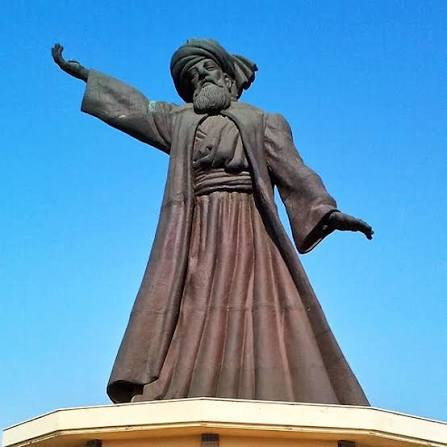
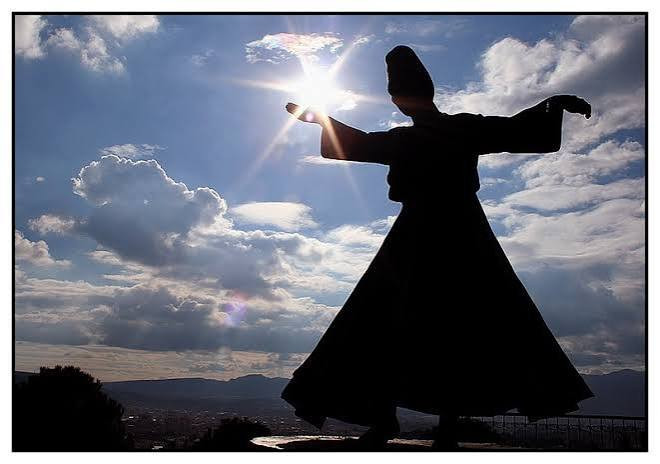
This is the foundation of the sama, the whirling dance that became the signature practice of the Mevlevi order founded after Rumi's death. For Rumi, sama was not a performance or a spectacle. It was a metaphysical act, a way of experiencing the truth beyond words. The dancer turns in circles, one hand pointing up to receive divine grace, the other pointing down to channel it to the earth. The music and the movement dissolve the ego, quiet the chattering mind, and open the soul to direct experience of the divine. Rumi believed music could focus a devotee's whole being so intensely that the soul was both destroyed and resurrected. The sama was a practice of fana' in motion, a physical manifestation of the soul's cosmic dance around the divine centre.
Rumi's Relevance Today
Rumi died on December 17, 1273, in Konya, a city he had made a centre of spiritual light. His followers, led by his son Sultan Walad, founded the Mevlevi order, the "Whirling Dervishes," who preserved and propagated his teachings for centuries. His tomb in Konya—the Mevlana Museum—remains a site of pilgrimage for people of all faiths.
But Rumi's true legacy has only grown with time. In the modern West, he has become the best-selling poet in America. This phenomenon speaks to something profound about our age. In a world that often feels fragmented, anxious, and spiritually empty, Rumi offers an antidote. He does not offer a new system of belief or a set of doctrines to assent to. He offers direct, visceral, passionate engagement with the deepest questions of existence. His poetry is not about God in the abstract; it is about you and your relationship to the source of your being.
His appeal also lies in his refusal to be contained by any single tradition. Though firmly rooted in the Islamic tradition of the Quran and the Prophet Muhammad, his message, as one scholar argues, places him as an "intercultural philosopher" whose ideas resonate with Vedanta, Buddhism, and Kashmir Shaivism. Rumi speaks across borders because his concern is not with the labels we wear but with the fire in our hearts. His poems are not theological treatises; they are invitations to a direct, unmediated experience of love.
The story of Rumi is the story of a man who lost everything—his reputation, his friend, his carefully constructed identity—and discovered that what remained was greater than anything he had possessed. In his work, the tragedies of his life became gateways to the infinite. He shows us that our wounds, our losses, and our deepest longings are not obstacles to spiritual life but its very substance. "The wound is the place where the Light enters you," he wrote. It is this audacious, life-affirming, and deeply human message that continues to speak to us, eight hundred years after a scholar in a black turban met a wild-eyed mystic and dared to let his world fall apart.
Twenty Memorable Sayings of Rumi
Rumi's words have travelled across eight centuries and countless languages because they speak to something universal. They do not lecture or preach; they invite, challenge, and gently dismantle the walls we build around ourselves. Here are twenty of his most memorable sayings, drawn from his poetry and prose, each carrying the unmistakable imprint of a mind that had touched the divine.
On Love and the Self
- "Your task is not to seek for love, but merely to seek and find all the barriers within yourself that you have built against it." This is Rumi at his most direct. He turns the entire enterprise of love on its head. You do not need to go out and capture love; you need to stop blocking it out. The work is interior, the labour is self-examination.
- Lovers don't finally meet somewhere. They're in each other all along." A companion to the first. Union is not a future event; it is the recognition of a truth that has always been present. This is his philosophy of fana'—the ego's illusion of separation dissolves, and what remains is the eternal connection.
- "The minute I heard my first love story, I started looking for you, not knowing how blind that was." The search itself is born of ignorance. He looked outward, not realising the beloved was within. The longing, he discovered, was itself a sign of the presence he sought.
- "The wound is the place where the Light enters you." Perhaps his most famous saying. It transforms suffering from an obstacle into an opportunity. The breaks and cracks in our carefully constructed selves are not failures; they are the very openings through which grace can enter.
- "What you seek is seeking you." A statement of profound reassurance. Your deepest longing is not a solitary ache; it is the echo of a reciprocal call. The universe, or the Divine, desires you as much as you desire it.
- "Stop acting so small. You are the universe in ecstatic motion." A rebuke to our petty self-judgements. We are not insignificant specks; we are manifestations of the cosmic dance. This is his evolutionary vision in miniature: we are not fixed beings but dynamic expressions of divine energy.
On Transformation and Inner Work
- "Yesterday I was clever, so I wanted to change the world. Today I am wise, so I am changing myself." A perfect summary of Rumi's shift from outward scholar to inward mystic. Cleverness seeks to control the external; wisdom recognises that the only thing we truly possess, and can truly transform, is our own soul.
- "If you are irritated by every rub, how will your mirror be polished?" The friction of life, the irritations, and the difficult people—these are not accidents. They are the tools that smooth and shine the heart's mirror so it can reflect the divine clearly.
- "Don't be satisfied with stories, how things have gone with others. Unfold your own myth." A direct challenge to live authentically. Do not borrow someone else's spiritual biography. Your path is unique, and you must walk it yourself.
- "Sell your cleverness and buy bewilderment." Reason and intellect have their limits. Beyond them lies a state of "bewilderment"—the holy confusion of one who has surrendered certainty in exchange for direct, unmediated experience. Intuition trumps mere opinion.
- "Knock, and He'll open the door. Vanish, and He'll make you shine like the sun. Fall, and He'll raise you to the heavens. Become nothing, and He'll turn you into everything." A four-line distillation of the Sufi path: active seeking, self-emptying, surrender, and eventual baqa'—the eternal life that follows the death of the ego.
- "Let yourself be drawn by the stronger pull of that which you truly love." Trust your deepest inclinations. The soul knows its own direction. Do not resist it with hesitation or fear.
- "Everything in the universe is within you. Ask all from yourself." You are a microcosm of the whole. Do not seek externally for what is already housed within you. The source is inside, waiting to be uncovered.
On Life, Loss, and Perspective
- "Don't grieve. Anything you lose comes round in another form." Rumi's antidote to attachment. Loss is not final; it is transformation. What leaves you will return, perhaps unrecognisable but present.
- "Where there is ruin, there is hope for a treasure." The rubble of a broken life is not a dead end. It is the excavation site for something precious. This is the hope that runs through his own story—the ruin of his scholarly life led to the treasure of his poetry.
- "Out beyond ideas of wrongdoing and rightdoing, there is a field. I'll meet you there." Perhaps his most famous invitation. It is a call to leave behind the prison of moral judgement and ego. Beyond duality, in the pure expanse of being, is where true encounter happens.
- "Silence is the language of God, all else is poor translation." Words, for all their beauty, are inadequate. They are approximations. The real communication, the direct transmission of the divine, happens in the silence beyond speech.
- "Why do you stay in prison when the door is so wide open?" A question that exposes our self-imposed limitations. We are prisoners of our own fears, habits, and identities. The escape route is always available; we simply refuse to take it.
- "We are born of love; Love is our mother." Love is not an emotion we occasionally feel; it is our very origin and essence. We return to our mother when we live in love.
- "My soul is from elsewhere, I'm sure of that, and I intend to end up there." The certainty of the mystic. He does not belong to this world of dust and form. His true home is the divine source, and he is simply passing through, with his gaze fixed firmly on his destination.
These sayings are not random aphorisms. Read them together, and they form a coherent map of the soul's journey: identify the barriers you have built; surrender your cleverness; embrace bewilderment; allow your wounds to let in the light; and know that the love you seek is already seeking you. That, in essence, is Rumi's enduring gift to the world.
References
- Schimmel, Annemarie. "Rūmī". Encyclopedia Britannica.
- "Rumi". Oxford Centre for Islamic Studies.
The Divine Wisdom Of Rumi
Who is Rumi?
One Hour with RUMI — The Journey That Will Change Your Soul Forever










Comments
0 comment