



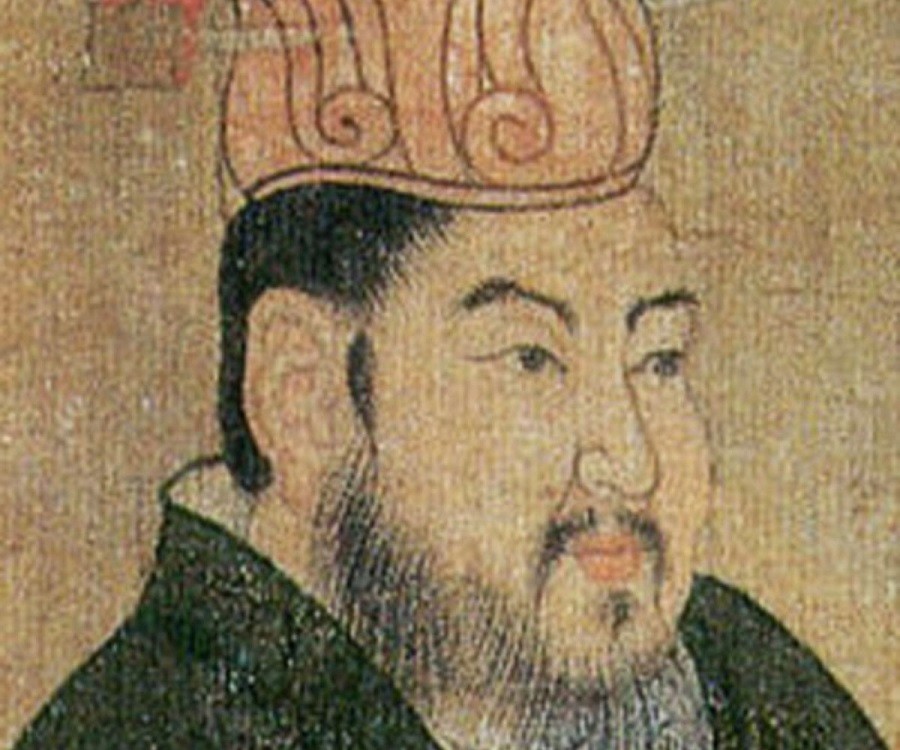

Middlke Reign
In spring 609, Ashina Rangan made another visit to Emperor Yang, and Emperor Yang again rewarded him with much treasure.
Also in spring 609, Emperor Yang ordered a redistribution of the farming land throughout the empire.
Later in spring 609, Emperor Yang conducted a tour of the newly conquered Tuyuhun territory, and sent several generals to chase down Murong Fuyun. The Sui forces engaged Murong Fuyun's remaining forces, with mixed success, but Murong Fuyun was forced to flee to Dangxiang tribes. Emperor Yang tried to impose Murong Fuyun's son Murong Shun, whom Murong Fuyun had earlier sent to Sui as a hostage, as Tuyuhun's new khan, but the Tuyuhun people would not accept him, and Murong Shun was forced back to Sui territory. Emperor Yang also received 27 rulers of Xiyu kingdoms in an audience at Zhangye (張掖, in modern Zhangye, Gansu).
Later in the year, Ashina Rangan died, and was succeeded by his son Shibi Khan Ashina Duojishi. Pursuant to Tujue customs, Ashina Duojishi requested permission from Emperor Yang to marry Ashina Rangan's wife Princess Yicheng (義成公主) (the daughter of a clansman of Emperor Yang). Emperor Yang agreed. Also in 609, Emperor Yang, jealous of the literary talent of the official Xue Daoheng (薛道衡), he falsely accused Xue of defaming the emperor and had Xue strangled.
By this time, it was said that Emperor Yang's lifestyle had become particularly wasteful, and that he no longer felt bound by moral principles.
In 610, Emperor Yang visited Jiangdu again, and this time elevated Jiangdu's importance so that it effectively became a third capital.
When Emperor Yang was visiting Ashina Rangan in 607, a messenger from Goguryeo's King King Yeong-yang to Ashina Rangan happened to be present, and Ashina Rangan introduced him to Emperor Yang. Emperor Yang ordered King Yeong-yang to come visit him, offering to reward him if he did so and to punish him if he did not do so. King Yeong-yang did not respond, and by 611, Emperor Yang, insulted by the lack of response, prepared a campaign against Goguryeo. With Sui appearing to be in its prime, both governmental officials and the people were initially in support of a campaign to conquer Goguryeo. In spring 611, Emperor Yang went to Zhuo Commandery and announced the campaign against Goguryeo. Several hundred men were conscripted, and it was said that even before they could get to Zhuo Commandery, disease and fatigue had already caused much loss of life. In response, a number of conscripted soldiers deserted and became agrarian rebels.
Also in 611, angry that Western Tujue's khan Ashina Daman, while nominally submissive, had refused to visit him, Emperor Yang had Pei Ju persuade Ashina Daman's subordinate khan Ashina Shegui (阿史那射匱) to rebel against Ashina Daman, promising to give him a Sui princess in marriage. Ashina Shegui thus rebelled against Ashina Daman, forcing Ashina Daman to flee, first to Gaochang, then to Sui. Emperor Yang accepted Ashina Daman's submission, and thereafter divided his people into three groups, while leaving Ashina Daman as titularly khan, although he never allowed Ashina Daman to return to his people.
By 612, the soldiers had been gathered at Zhuo Commandery, and Emperor Yang launched his attack, attacking a number of cities in Goguryeo territory, but targeting mainly at the important city of Liaodong (遼東, in modern Liaoyang, Liaoning) and Goguryeo's capital Pyongyang. However, contrary to the desires of the generals, Emperor Yang ordered that their tactical decisions must first be submitted to and approved by him before they could be carried out. Thus all the Goguryeo forts and cities were able to withstand Sui forces and thus there was not much chance of Manchuria being successfully conquered. Emperor Yang, however, made a new plan to keep the Goguryeo forts at bay while sending another army, alongside the navy. to siege the Goguryeo capital. The navy arrived first and with a haste order, the navy attacked the capital but were defeated by ambush. The navy then waited for the land army to arrive. The supply of food had also been greatly delayed and many Sui soldiers died of famine. Then the Goguryeo General Eulji Meundeok rallied Goguryeo forces, and constantly harassed them with ambushes and feigned retreats. The Sui army had come to the Salsu River, but Eulji and the Goguryeo forces were waiting in ambush. A dam was made at the Salsu River to make the river seem it was shallow. When the Sui army was in the middle of the River, the dam was opened and many Sui soldiers drowned. Out of the 305,000 men that entered the river, only 2,700 soldiers escaped death. Thus the Sui army, or what was left of it, retreated back to Sui. This war had, however, resulted in devastating losses for the Sui in terms of soldiers, money and support from the people.
In winter 612, Emperor Yang gave a daughter of a clansman, whom he created the Princess Huarong, to Qu Boya (麴伯雅) (the king of Gaochang) in marriage
In spring 613, Emperor Yang again ordered that soldiers be gathered at Zhuo Commandery, as he prepared a second campaign against Goguryeo. He also selected the most elite of the soldiers into a specialized corps, the Xiaoguo Army (驍果, meaning, "the strong and brave"). Thereafter, the Xiaoguo Army became his own personal guards. In response to the conscription order, even more men deserted and joined the agrarian rebels, throwing the northern central part of the empire into a state of confusion. With the officials on command having little military training, the rebels went largely unchecked. One notable exception was general Zhang Xutuo (張須陀), who was able to defeat some of the rebels, but even he was not able to succeed in suppressing them.
In summer 613, Emperor Yang crossed the Liao River again and put Manchuria under siege. However, at this time, news arrived that Yang Su's son Yang Xuangan had rebelled near Luoyang. With the people disaffected by the Goguryeo campaigns, Yang Xuangan received much popular support and threatened Luoyang. Emperor Yang, in fear, lifted the siege on Liaodong and also ordered the southern offensive to be terminated, returning to Zhuo Commandery while sending Yuwen and Qutu Tong (屈突通) south to aid Luoyang. The general in charge of defending Chang'an, Wei Wensheng (衛文昇), also came to Luoyang's aid. Together, these forces outnumbered Yang Xuangan's and dealt him several defeats. Yang Xuangan decided to try to advance west to capture Chang'an as a base of operations, but on the way was again defeated, and he had his brother Yang Jishan (楊積善) kill him, to avoid capture. At Emperor Yang's orders, the officials Fan Zigai (樊子蓋) and Pei Yun (裴蘊) carried out mass-scale reprisals, executing a large number of people who had followed Yang Xuangan. Around the new year 614, by Emperor Yang's orders, Yang Jishan and Yang Xuangan's strategist Wei Fusi (韋福嗣) were publicly executed in exceedingly cruel manners—the officials all fired arrows at them, and then they were further drawn and quartered, and then their bodies were burned and the ashes scattered.
Around the same time, there were also rebellions south of the Yangtze River, and Emperor Yang sent the official Wang Shichong against the rebels. Wang was able to suppress the rebellions, for the most part, and thereafter began to rise in prominence at Emperor Yang's court. Meanwhile, Emperor Yang ordered that rebels' possessions could be confiscated at will. The local officials, however, used this as an excuse to execute and confiscate properties of those they did not like.







Comments
0 comment