





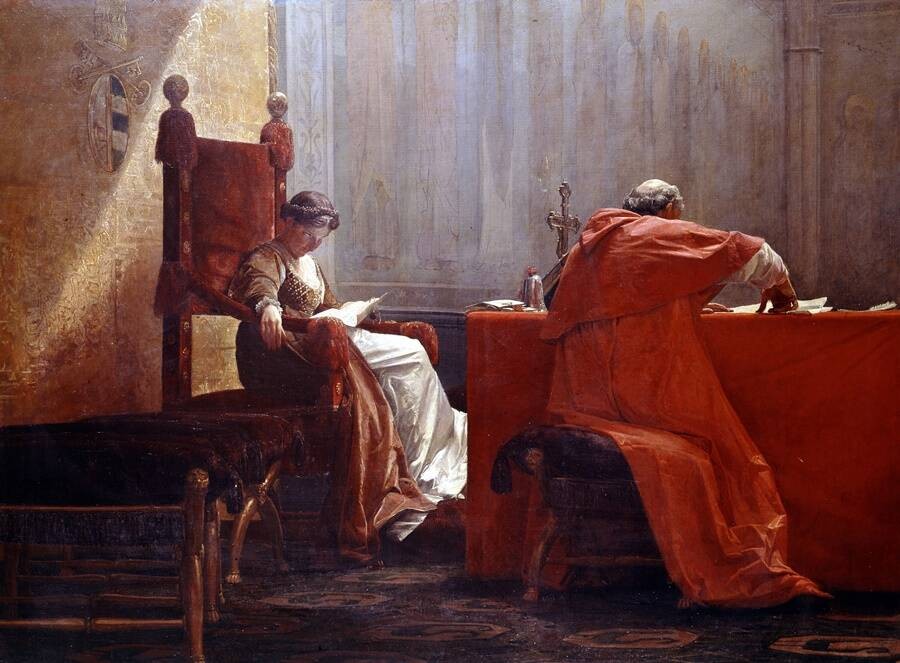
 Young Lucrezia sitting beside her father, the pope. Enemies of the Borgias spread rumors that the father and daughter were engaged in an incestuous affair, but historians believe these stories were politically motivated.
Such scandals plagued the Borgia name throughout history — and rightfully so given that many of their reported misdeeds truly happened. But it is important to put their exploits within the context of the Renaissance era, when noble families of Italy like the Colonnas, the Medicis, and the Della Roveres all schemed their way to positions of power through similar if not worse acts.
Likewise, others corrupted the papacy long before Pope Alexander VI. In 1458, for example, Cardinal Guillaume d’Estouteville promised lucrative rewards to anyone who would vote for him. In that same era, Pope Martin V — born Otto Colonna — secured estates for his relatives in the kingdom of Naples throughout his papacy.
So why were Pope Alexander VI and his Borgia kin more vilified than their peers? Experts believe their identity as Spanish outsiders contributed to their infamy.
Pope Alexander VI died in 1503 after a mysterious disease caused his body to bloat and become discoloured. His death came a few days after a dinner with Cardinal Adriano Castellesi, who was supposedly the target of a poisoning scheme by Cesare. Many suspected the pope’s son had accidentally poisoned his father instead of Castellesi. Other historians, however, theorise that the pope had succumbed to malaria.
But even with Pope Alexander VI gone, his filthy legacy remained. Julius II, who succeeded Alexander, famously said,
“I will not live in the same rooms as the Borgias lived. He desecrated the Holy Church as none before.”
Indeed, the Borgias’ apartments remained sealed until the 19th century, more than 300 years after their misdeeds rocked the Vatican to its core.








Comments
0 comment