





Gee John

According to Jeff Burbank at The Mob Museum, Nevada became the first state government to make lethal gas a death penalty punishment as part of a “Humane Death” bill, which passed through both chambers of the Nevada Legislature. One legislator said the gas would kill a prisoner “without warning and while asleep in a cell.” While the governor of Nevada didn’t support the death penalty, he signed the punishment into law.
Gee Jon was a Chinese immigrant born into the Qing Dynasty in China. As a man of Cantonese descent, Gee came to America when he was young, and grew up in San Francisco.
Once he was an adult, Gee became a member of the Hop Sing Tong, a Triad organized crime group in San Francisco. At the time, the Hip Sing Tong had a feud with a rival organization, and Gee traveled to a mining town in Nevada called Mina to kill a man in a rival organization.
According to Scott Christianson in The Last Gasp: The Rise and Fall of the American Gas Chamber, Gee killed another Chinese immigrant, and he became an ideal target for experimentation for the gas chamber because the early 1920s included “a wave of anti-immigrant and racist hysteria.” At the time, Tong warfare across all of the West led to many murders, especially in California.
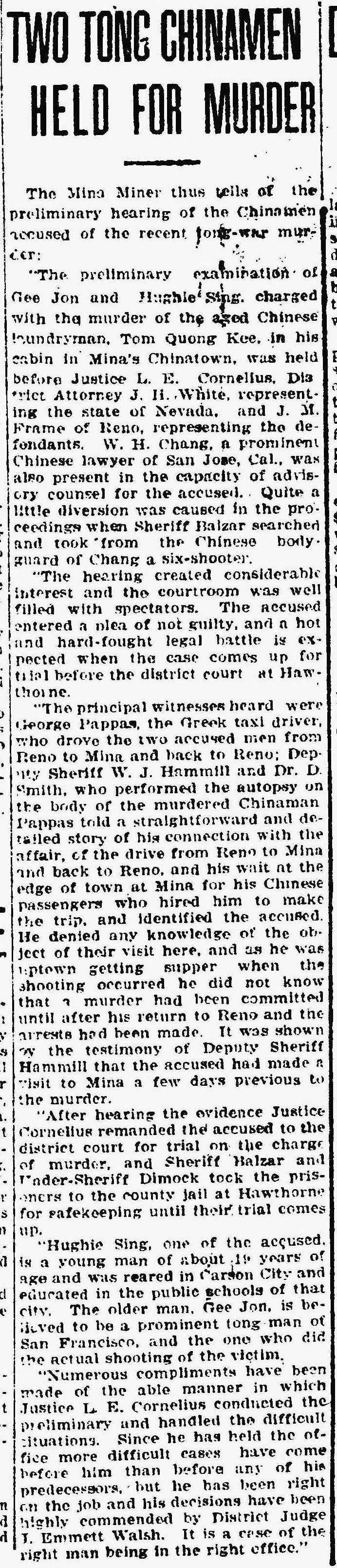
A 1921 account in the Nevada State Journal states Gee and his apprentice, Hughie Sing, killed a laundryman named Tom Quong Kee in Mina’s Chinatown. Gee and Sing were represented by attorneys J.M. Frame and W.H. Chang. It’s also important to note that Gee was a Chinese immigrant and Sing was white, making an appearance of racial disparity in the unequal treatment between the two.
Apparently, during the trial, Chang brought his bodyguard, and the sheriff confiscated a revolver from Chang’s bodyguard, an incident the news account calls “quite a little diversion.”
It was a popular trial — the courtroom was packed with spectators. Gee pleaded not guilty. However, multiple witnesses testified against him and Sing. The Greek taxi driver who drove both men to kill Kee said he drove them from Reno to Mina and then Mina to Reno. Taking I-95N today, this would have been an approximately 160-mile drive taking at least three hours, and we can imagine it took longer than six hours round trip for the driver to go back and forth from Reno to Mina in 1921. The driver, Pappas, denied any knowledge of what Gee and Sing were doing on their visit to Mina. While they were performing the hit, Pappas went to get dinner, and he said he was completely unaware there was a murder in the first place.
A sheriff and doctor who performed the autopsy on Kee also testified. Sing was young and had just exited public schools in Carson City, while Gee was much older — the news account said Gee was believed to have actually shot Kee.
After Gee was indicted for murder, he was soon convicted and sentenced to death on August 27th, 1921. Sing had his sentence commuted to life in prison.










Comments
0 comment