





The Sun is the best Cameraman
 Illustration of the camera obscura principle from 1755 in a book written by James Ayscough. Courtesy of Wikicommons
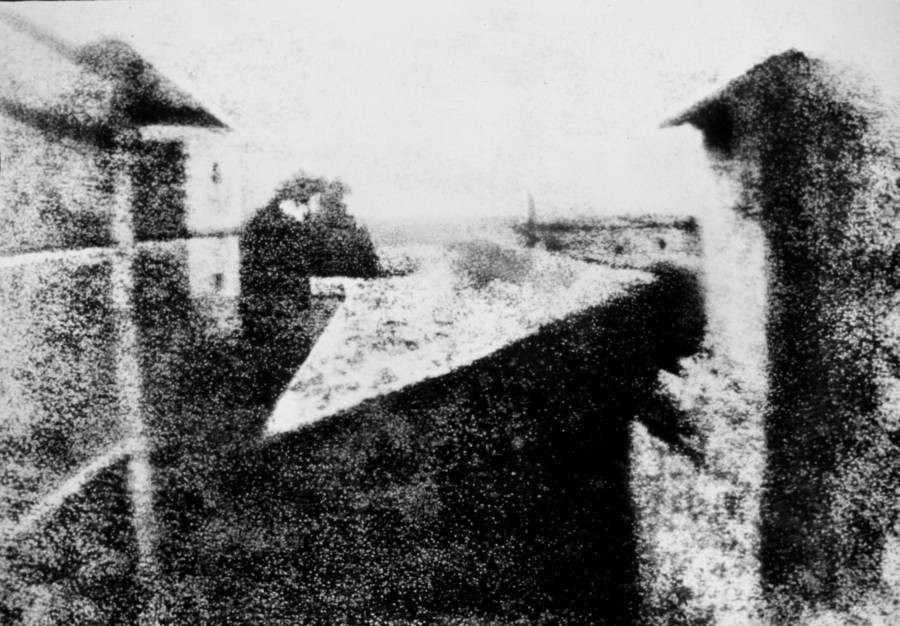
Many theories about capturing images came before the early 1800s but all had the same process behind it as the method used to create the above “Window at Le Gras”. A light-sensitive chemical was used in tandem with a ‘camera obscura’ to imprint an image on a surface.
This process created what we now know as ‘negatives’ meaning a picture which displays dark areas as light and vice-versa. By using these two processes in tandem an upsidedown negative of anything could be produced. The first person to successfully implement this theory was Nicéphore Niépce.
To create the famous picture in the thumbnail of this article Niépce used a plate of ‘pewter’, an alloy mainly composed of tin, and ‘Bitumen of Judea’ also known as ‘Syrian asphalt’ which is a naturally occurring asphalt. Niépce chose the ‘Syrian asphalt’ for his experiment due to its known light-sensitive quality.
Niépce coated the plate of pewter with the light-sensitive chemical and placed it in the camera obscure which was pointing out of a window of his estate in Saint-Loup-de-Varennes known as “Le Gras”, hence the name of the photograph. The result of this process can be seen in the thumbnail of the article and below in differing levels of clarity.






Comments
0 comment