




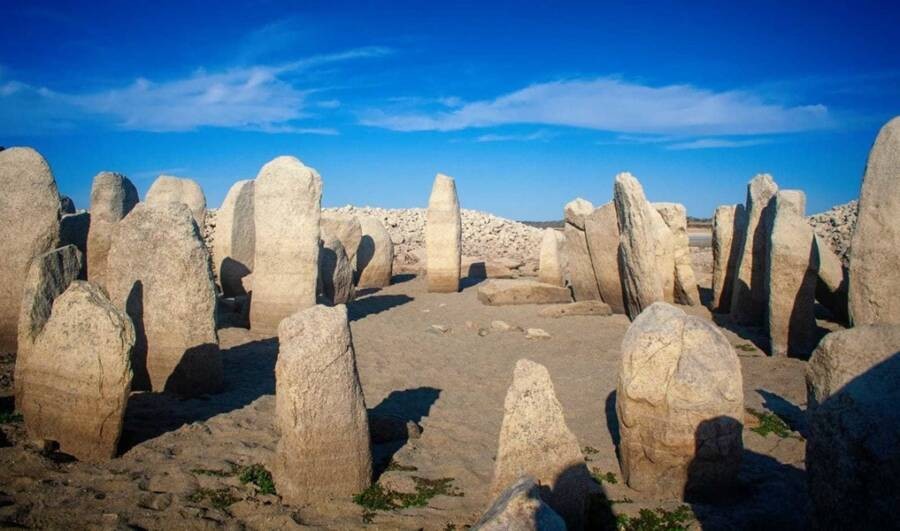
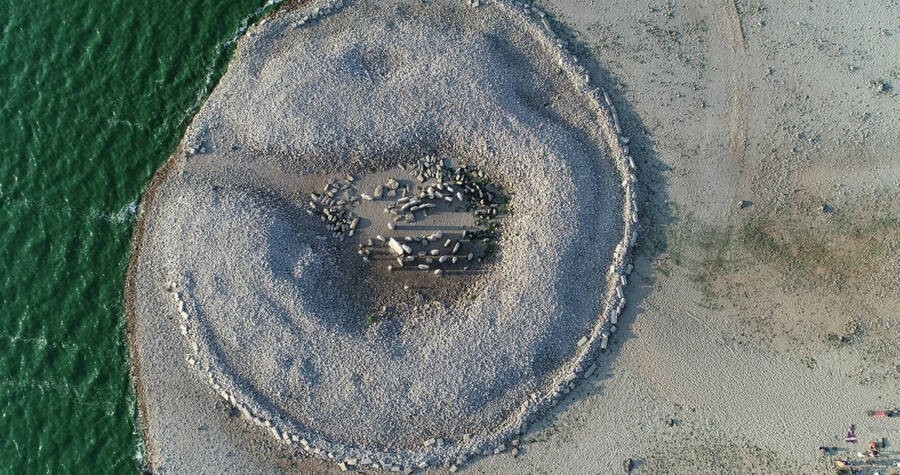
If water were to drown an entire archaeological site today, there would most certainly be an immediate backlash from historians and researchers, which is currently happening with the soon-to-be flooded historical site of Hasankeyf. But back then, the dolmen’s flooding was simply accepted.
Primitiva Bueno Ramirez, a specialist in prehistory at the University of Alcalá, explained that the importance of archaeological studies back then weren’t as appreciated as they are now, and there was no standard practice for creating environmental reports before such a massive project was greenlit.
“You couldn’t believe how many authentic archaeological and historic gems are submerged under Spain’s man-made lakes,” Ramirez said.
The re-emergence of the Dolmen de Guadalperal has no doubt excited archaeologists, who believe that the stones in the structure were transported from three miles away on the banks of the Tagus River, the longest waterway in the Iberian Peninsula, sometime in the fifth millennium BC. It was meant as a burial place and a temple to worship the sun.
Scientists believe that, though its current shape appears to be that of an open-air, unfinished circle, the monument was once entirely enclosed, complete with a roof on top.
According to Ramirez, people would have entered through a narrow hallway adorned with engravings and other decorations to access the original structure. The hallway would lead into a more spacious main chamber that was 16 feet across, where the dead were likely kept.
He also said that it is likely the monument was oriented around the summer solstice, allowing the sun to shine upon the community’s buried ancestors.
Now that the Dolmen de Guadalperal has resurfaced, Castaño and his organization are hoping to get the monument permanently moved to a higher, drier place so that the structure doesn’t suffer more damage to its already eroding surface.
At its current location, the dolmen stands a few dozen yards away from the manmade lake. Time is of the essence as the drought is suspected to be temporary, meaning that the ancient structure could get drowned again in a month.
“Whatever we do here, needs to be done extremely carefully, Ramirez said. “We need high-quality studies using the latest archaeological technology. It may cost money, but we already have one of the most difficult things to obtain—this incredible historic monument. In the end, money is the easy part. The past can’t be bought.”
written by Natasha Ishak










Comments
0 comment