





Jinn In Popular Culture
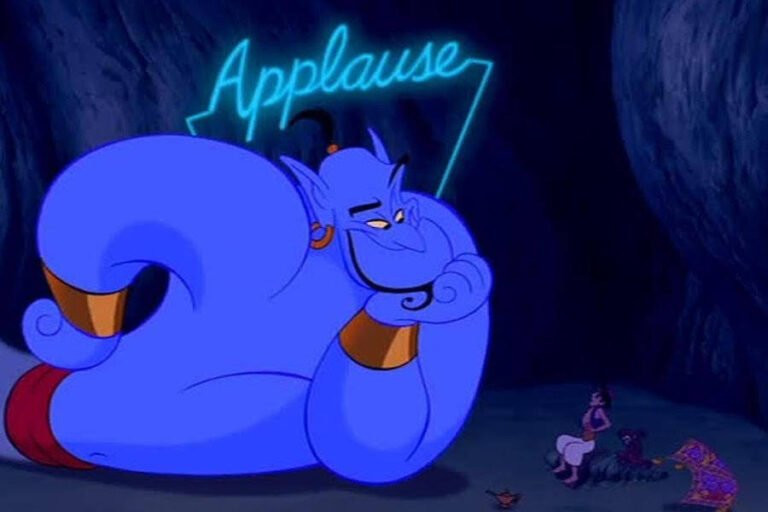 The genie in Aladdin is perhaps the most famous jinn in popular culture.
More recently, Netflix’s first Arabic original series Jinn caused a furor in Jordan over its “immoral scenes.” Set in Petra, youths attempt to save the world from jinn, which seems like a simple enough premise. But the outrage in Jordan actually stemmed from a girl in the show kissing two different boys in separate scenes.
For centuries, many have believed that jinn wreak havoc on the world. If they’ve survived — at least in the minds of people — for this long, it’s unlikely they’ll disappear anytime soon.
More recently, Netflix’s first Arabic original series Jinn caused a furor in Jordan over its “immoral scenes.” Set in Petra, youths attempt to save the world from jinn, which seems like a simple enough premise. But the outrage in Jordan actually stemmed from a girl in the show kissing two different boys in separate scenes.
For centuries, many have believed that jinn wreak havoc on the world. If they’ve survived — at least in the minds of people — for this long, it’s unlikely they’ll disappear anytime soon.
Jinn operate in a somewhat grayer area than demons from Christianity, as they oscillate between good and evil and thus behave more comparably to humans.
While Aladdin did accurately convey that, the character’s charming nature clearly veered from the spookiness of traditional folklore. But Aladdin’s genie is far from the only well-known jinn character. One Thousand and One Nights, a collection of famous folk tales from the Islamic Golden Age, explored the ancient entity as well.
“The Fisherman and the Jinni” sees a fisherman discover a jinn trapped in a jar that he finds in the sea. Although the spirit is initially furious about being trapped inside for centuries, it eventually provides the man with exotic fish to give to a sultan.
Seventh-century Islamic Prophet Muhammad famously acknowledged the existence of jinn in the Qur’an — as non-material beings who have free will like humans. While El-Zein believes “one can’t be Muslim if he/she doesn’t have faith in jinn existence,” it’s nearly impossible to confirm that all 1.6 billion Muslims in the world share that view.
For many of those who do, however, jinn are considered part of the unseen, or al-ghaib. Faith in their power is so strong that it’s not unheard of for people to seek out exorcisms to get rid of them. These rituals often involve reciting the Qur’an over a person, but they have varied widely over the years.
“The Arabs of pre-Islam invented a whole set of exorcism procedures to protect themselves from the evil actions of the jinn on their bodies and minds, such as the use of beads, incense, bones, salt, and charms written in Arabic, Hebrew, and Syriac, or the hanging around their necks of a dead animal’s teeth such as a fox or a cat to frighten the jinn, and keep them away,” El-Zein said.
While these spirits aren’t entirely good or bad, jinn are lower in rank than angels — and are oftentimes believed to be capable of human possession.
A 2014 study found that “the attribution of psychiatric symptoms to jinn is common in some Muslim populations.” Jinn have also reportedly appeared in some truly creepy firsthand encounters.
One girl claimed a bully at a boarding school nearly choked when her tongue swelled up after she broke another student’s necklace. The student in question then began speaking in a male voice — claiming to be a jinn who had traveled from afar. Only later did her parents reveal that they bought the jewelry from a shaman specifically to hold in the malevolent spirit.
More recently, Netflix’s first Arabic original series Jinn caused a furor in Jordan over its “immoral scenes.” Set in Petra, youths attempt to save the world from jinn, which seems like a simple enough premise. But the outrage in Jordan actually stemmed from a girl in the show kissing two different boys in separate scenes.
For centuries, many have believed that jinn wreak havoc on the world. If they’ve survived — at least in the minds of people — for this long, it’s unlikely they’ll disappear anytime soon.
Marco Margaritoff











Comments
0 comment